
ENDLESS GARDENS

A seemingly frail old man carries his shotgun into the front yard and begins shooting upwards. The drivers in the three lanes of traffic panic as they pass by. Though this predates cell phones, they are able to call the police. Upon arrival they say, “Now Tom, you know you shouldn’t shoot in the front yard. “ He replies, “Those squirrels were eating my nuts!” Clearly it’s not the first time he’s defended his crop or that the police have been called out. Somehow there’s mutual respect. Each is just doing their job. So are the squirrels. Does the problem lie with the drivers, then? Surely they are just trying to prevent an accident.
In a world increasingly dominated by digital interactions, the importance of listening to multiple perspectives has never been more critical. As an artist, I find myself contemplating the intersections of memory, perception, and identity in this complex landscape. The rapid evolution from an analog to a digital existence raises essential questions about how we form our beliefs and how these beliefs can be influenced—sometimes insidiously—by the environments we navigate.

Memory, too, plays a pivotal role in how we interpret the world around us. The digital age shapes our memories—what we remember and how we remember it is influenced by the media we consume. Photographs, social media posts, and articles can transform ephemeral moments into lasting impressions, often blurring the line between reality and representation. This interplay raises concerns about the authenticity of our memories, individual and collective.
Radicalization often arises when individuals are isolated within echo chambers, where one viewpoint drowns out all others. In a digital realm that thrives on algorithmic curation, we risk reinforcing our biases rather than challenging them. As artists, if we close ourselves off from diverse perspectives, our works may reflect a singular vision, failing to capture the rich tapestry of human experience.
The old man is my great-grandfather and the story is true as told to me by someone, maybe my father. The tree you see printed on the fabric hanging outside is his pecan tree in a google street view before the city cut it down to widen the sidewalk. The tree that grew so big is now a memory just like the moments I spent on that property during my childhood. My grandmother and great grand-parents built these houses and lived side by side until their deaths. My great-grandparents tilled the land and sold flowers, strawberries and eggs to the grocery store.
I spent summers and weekends there, playing outside while my grandmother cared for her flower beds after work. I remember dirty feet, catching fireflies, feeding chickens, playing with kittens, hanging with the dog and talks with my great-grandfather as he whittled sticks with his pocket knife. I am comforted by the sound of my grandmother’s laugh and the fact that it remains in my brain.
I have taken specific memories and fed them into an AI image generator. I had to write and rewrite the text over and over again. It kept getting it wrong. While AI offers incredible potential to innovate and inspire, it can also dilute the richness of genuine human interaction.

Let’s not only plant our own gardens, but marvel at those planted by others. Each one is unique with its individual conditions and gardener. Let’s celebrate our analog connections—the warmth of face-to-face conversations, the nuances of voice and body language, and the power of shared silence. The line through the analog past, the digital present and a meaningful future is connected by empathy and open-mindedness. Though my entire installation is digital, I hope you return to the innocence of physical engagement and roll on the grass, ride my memories, watch the squirrel eat nuts and marvel at the pecan tree that grew so big. Maybe you’ll even remember something you experienced and share it with a stranger instead of on instagram. Plant the seeds.
Who’s Who
Can AI construct a life to give memory to those long forgotten?

In 1909 Mitteldeutschen Braunkohlensyndikat was founded with the goal of keeping heating affordable for everyone. Representatives from all the coal mines sat at the table and set the prices together. Since 2015 the building has been home to 35 residents who run Goase e.V., a non-profit dedicated to bringing cultural events and projects to the neighborhood. When clearing the building they found a lot of papers that revealed names and dates but little else. I used names to create keywords, providing the basis for AI to create a series of portraits using the internet’s collective image database.
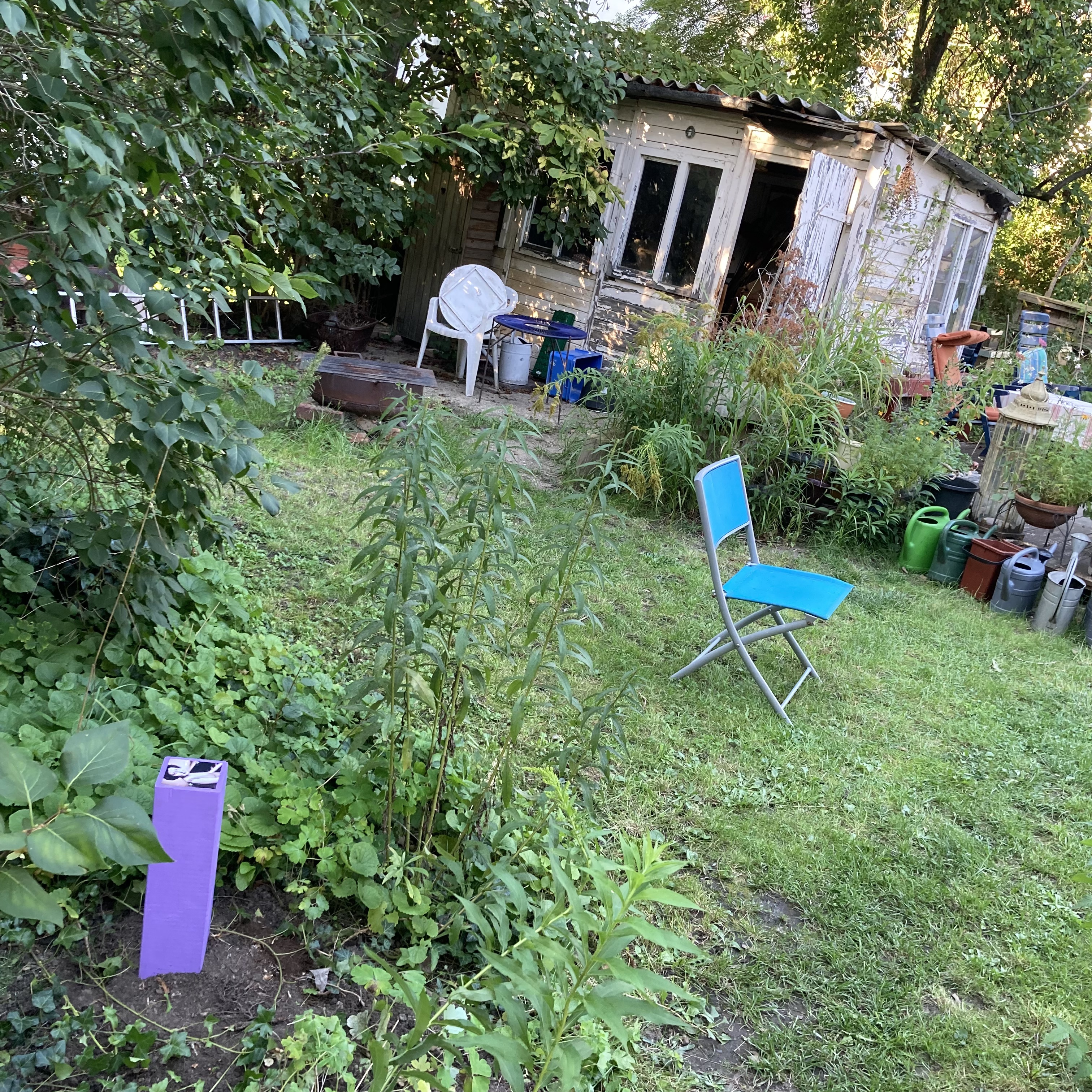
The AI generated images were then given personalities and placed in the communal garden behind the house according to imagined desires. The Cuban chef was placed near the pizza oven. The piano teacher was placed near the beehives, so she could listen to their buzzing. The older woman was placed where she could look at both the mature roses and the windows of the tower block next door. When they lived there, each flat had its own section of the garden. Now the past shares it with the present.
given info:
Hermann Garde 1920 miner who rose to be a member of the City Council
Name Unknown, Cuban chef who lived there in the 80s. He loved spices.
Erika Raußendorf 1931
Lucie Steindorff 1925 piano teacher
Ursula Krug 1933
Who’s Who
2023
AI generated images on AluBondn on wooden memorial plinths
Permanent Collection
Goase e.V.
Mitteldeutschen Braunkohlensyndikat
Richterstraße 4 + 6
Leipzig
Cats in Dresses
A photo of moment my grandmother thought worthy of immortalising in analog has long
been lost, but the memory of it is embedded in my brain. Can I recreate it through the
collective memory of people in our time? With each new piece of information I remember,
I reach out to AI.
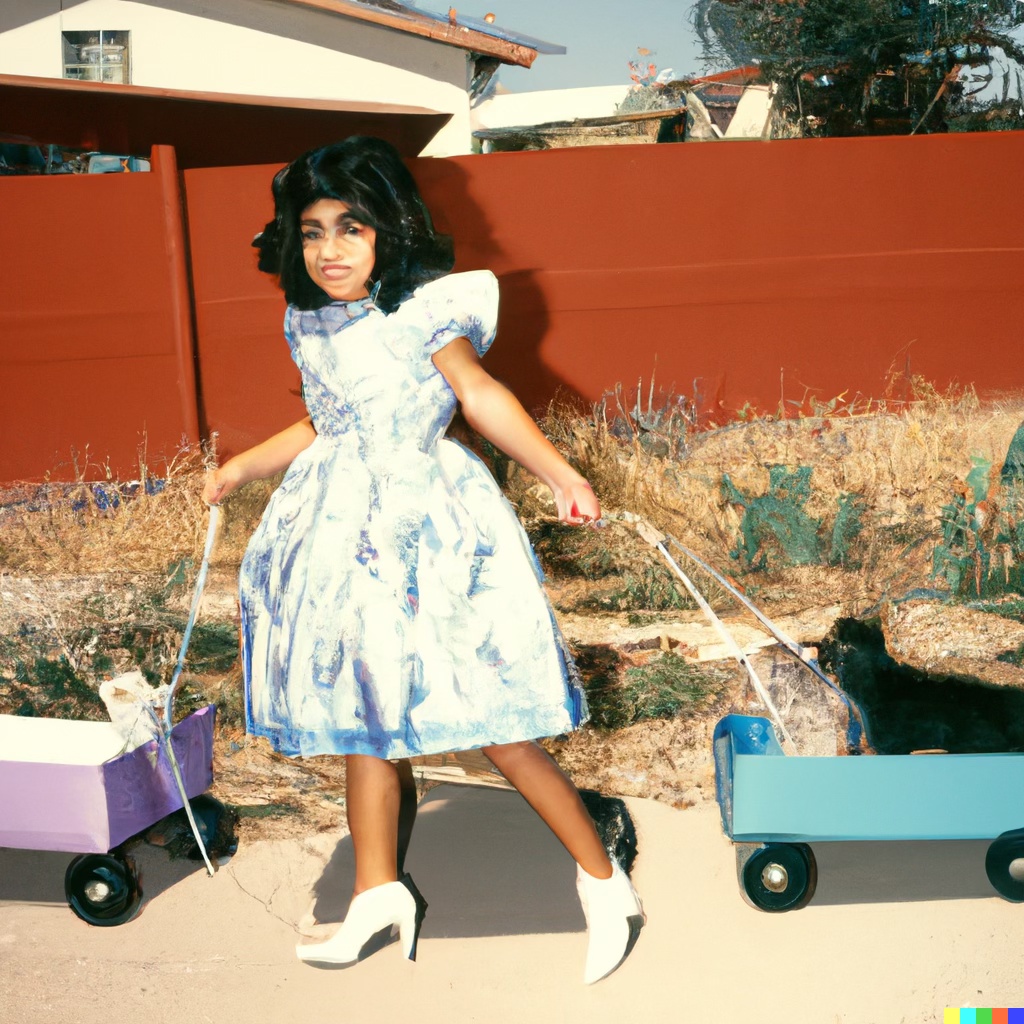
I spent every weekend and most of the summer at my grandmother’s. I loved playing outside while she gardened. Dress-up was my favorite game. I had my own closet with her old clothes, shoes and hats. My playmates were cats. There were always kittens. It makes sense that as a teen when I was looking through old photos, I would find one of me in over-sized glamour, pulling a wagon full of kittens wearing dresses. I remember being surprised the kittens would let me do that, but I also know that I am a bit of an animal whisperer. I have tried time and time again to find that photo. I have asked my dad and my step-mother. No one knows what happened to it.
Cats in Dresses is a series of images created with AI by inputting more and more key words as my memory of that time becomes more clear. Since AI is always learning, am I training it to create a closer replica? It draws upon the world’s collective consciousness to assemble data.
Can it ever recreate what my grandmother saw? Would I recognize it if it did?
cat’s in dresses
2023-ongoing
Square fine art Images printed on AluBond
 maeshelle west-davies